
1504. Count Submatrices With All Ones
Given an m x n binary matrix mat, return the number of submatrices that have all ones.
Example 1:
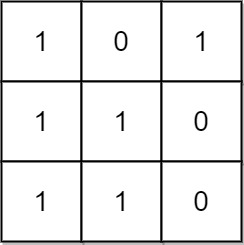
Input: mat = [[1,0,1],[1,1,0],[1,1,0]]
Output: 13
Explanation:
There are 6 rectangles of side 1x1.
There are 2 rectangles of side 1x2.
There are 3 rectangles of side 2x1.
There is 1 rectangle of side 2x2.
There is 1 rectangle of side 3x1.
Total number of rectangles = 6 + 2 + 3 + 1 + 1 = 13.
Example 2:
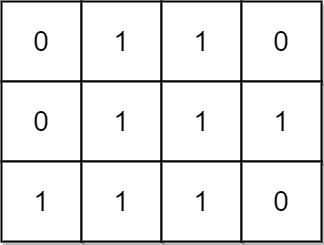
Input: mat = [[0,1,1,0],[0,1,1,1],[1,1,1,0]]
Output: 24
Explanation:
There are 8 rectangles of side 1x1.
There are 5 rectangles of side 1x2.
There are 2 rectangles of side 1x3.
There are 4 rectangles of side 2x1.
There are 2 rectangles of side 2x2.
There are 2 rectangles of side 3x1.
There is 1 rectangle of side 3x2.
Total number of rectangles = 8 + 5 + 2 + 4 + 2 + 2 + 1 = 24.
Constraints:
1 <= m, n <= 150mat[i][j]is either0or1.
class Solution {
public:
    int oneDArrayCount(vector<int>& vec){
        int consecutive = 0;
        int subCount = 0;
        for(int &val:vec){
            if(val==0){
                consecutive = 0;
            }else{
                consecutive++;
            }
            subCount += consecutive;
        }
        return subCount;
    }

    int numSubmat(vector<vector<int>>& mat) {
        int m = mat.size();
        int n = mat[0].size();
        int result = 0;

        for(int startRow=0;startRow<m;startRow++){
            vector<int> vec(n,1);
            for(int endRow=startRow;endRow<m;endRow++){
                for(int col=0;col<n;col++){
                    vec[col] = vec[col] & mat[endRow][col];
                }
                result += oneDArrayCount(vec);
            }
        }
        return result;
    }
};
Complexity:
Space → O(m^2 * n)
Time → O(n)

